The lesson ends and the paper doesn't make any sound. Build the progression in the lesson, loop it over a pad, send it home on the phone. One chart for nine instruments, Nashville numbers for beginners, chords from the YouTube lesson, PDFs for the folder, and no account or ads on a kid's phone.
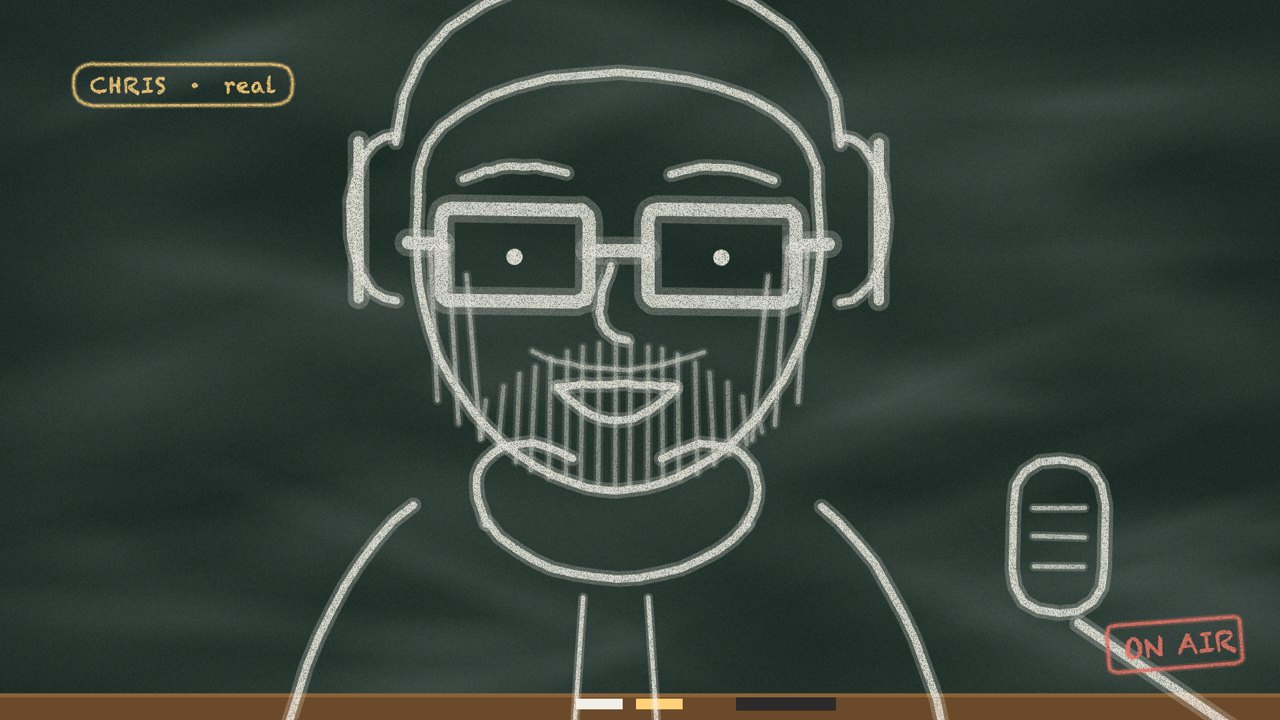
Who's talking. Chris is a real person. This is his voice, cloned, reading words he wrote and is responsible for. He digitized himself because there's one of him and a lot of hours he's asleep for. Nova, the co-host, is fully synthetic. The apps contain no AI.
Chapters
Free to start on Chrome, iPhone, iPad, Mac and Android. Pro $39.99 a year or $9.99 a month, 7-day trial.
Subscribe
New episodes every other Tuesday.
Transcript
NovaShop Talk from Creedy Solutions. I'm Nova, I'm the synthetic co-host, and Chris builds the apps. Chris, you're on a chalkboard this week, which feels like a hint about who we're talking to.
ChrisYeah, it's for the teachers this time, and I'll do the short disclosure for anybody new. I'm a real person, this is my voice, I wrote it, and I'm responsible for it, and I digitized myself so I could be in more than one place at once, which is the only way a one-person shop gets a podcast. Not Skynet, not Ultron, just a guy with a guitar and a laptop and too many ideas for one body.
NovaChris, I'll be honest about my bias going in. Teachers already own a metronome and a chord book, and they've been teaching fine without an app. Why would they bother?
ChrisSo I want to be careful here, because I'm not a teacher, I was the student, for a long time, and a pretty bad one at first. And the thing I remember is that the lesson ends, you go home, and you've got a sheet of paper and a metronome, and the paper doesn't make any sound. So you play the chords with nothing under them, and you don't know if you're right, and by Wednesday you've drifted, and the teacher spends the first ten minutes of the next lesson undoing Wednesday. That's the gap I think Chartless fills, the part between lessons, where nobody's listening.
NovaSo this is a homework tool.
ChrisIt's a practice room, I'd say, and the difference is that it makes sound. The teacher builds the progression in the lesson, so G, C, D, whatever the kid is on this week, sets the tempo, and loops it over a pad, and the kid takes that home on the phone and plays along with it. And now the chords are under them, so when they're wrong they hear it, which is the thing the paper can't do.
NovaChris, most teachers have more than one kind of student. The uke kid at four, the guitar kid at four thirty, somebody's dad on bass at five.
ChrisRight, and that's the part I'm kind of proud of, because it's the same chart for all of them. Chord diagrams for nine instruments, so guitar, ukulele, mandolin, base, banjo, piano, and so on, in thirty-something tunings, and a left-handed flip for the kid who holds it the other way. So you build the song once and the uke kid sees uke shapes and the guitar kid sees guitar shapes, and the teacher isn't redrawing anything.
NovaAnd for the piano student?
ChrisSame chords, shown as keys, and the loop plays on a piano instead of a pad if that's what they're used to hearing. There are a hundred and twenty sampled instruments in there, which is more than anybody needs, but the one you need is probably in there.
NovaHere's where I'm curious, Chris. You keep bringing up Nashville numbers. Is that something a teacher would actually use with a beginner?
ChrisI think it's the single best thing you can hand a beginner, and I say that as somebody who learned it embarrassingly late. So the song is G, C, D, and the kid learns it as one, four, five, and then next week the song is in A, and it's still one, four, five, and they already know it. Chartless shows the chart as numbers with one tap, and you can transpose the whole song into whatever key the kid can sing, and the numbers don't move. And that's the moment, honestly, where a student stops memorizing and starts hearing, and I think a teacher can get them there a lot faster with the numbers right on the screen.
NovaAnd transpose helps the singer, too.
ChrisIt does, because the song is in E on the record and the kid sings it in C, and you just move it, and the chart follows, and the capo advisor tells the guitar kid where to put the capo so they're still on open shapes. So nobody's doing math at the lesson, which, I mean, the math is the part that made me quit the first time.
NovaChris, a lot of teaching happens off a video now. A YouTube lesson, a backing track, a recording the student brought in.
ChrisYeah, so the Chrome extension lives in the side panel next to the video, and you hit Chart and it shows the chords as the song plays. So the teacher pulls up the recording the student wants to learn, and instead of the teacher working it out by ear while the kid waits, the chords are just there, and you can get to the teaching part. And it'll read the whole song into bars after, so that becomes the chart, and that chart goes to the practice loop, and the kid takes it home. It's one flow, record to chart to loop, and I think that's the part that saves the lesson minutes.
NovaIs the chord detection good enough to teach from?
ChrisIt's good, and it's not perfect, and I'd rather say that than have a teacher find out. Simple mode locks it to the seven chords in the key, which is where beginner songs live, so it's right a lot more often there. And when it's wrong the teacher's ear catches it, you tap the chord and fix it, and honestly that's a teaching moment too, because the kid just watched somebody hear a wrong chord and correct it.
NovaWhat about the old way, Chris? Paper in a folder.
ChrisStill works, and I'm not going to pretend it doesn't. So every song in Chartless turns into a chord sheet, and you print it to PDF, and that goes in the folder. And the Songs library keeps every song with its key and tempo, so a teacher ends up with a little catalog of everything they've taught, without trying to.
NovaAnd the tuner. Every lesson starts with tuning.
ChrisEvery lesson starts with tuning, and half the time the kid's guitar has been in a cold car. The tuner is one you can watch, it tells you which string, the needle settles, and there are presets for every tuning in the app. And I think watching the needle is a skill, actually, because the kid who learns to see it settle learns to hear it settle, eventually.
NovaChris, the question every teacher will ask. What does this cost a student, and what are they signing up for?
ChrisSo, no account, no ads, nothing to sign up for, and I was stubborn about that because it's going on a kid's phone. The free part is real, so the tuner and presets, guitar diagrams, chord sheets and PDF, practice loops on the pad, and ten minutes a day of live charting. Pro is thirty nine ninety nine a year or nine ninety nine a month, and that's unlimited charting, transpose, the capo advisor, every instrument and tuning, Stage view, and the full sound bank. Every install gets seven days of everything first, no card, so a teacher can try the whole thing on a Tuesday and decide by the next Tuesday.
NovaLast one, Chris. If a teacher tries exactly one thing with one student this week, what should it be?
ChrisBuild the progression they're working on, right there in the lesson, set it to a tempo that's a little slow, and send it home on the phone. And then next week ask them if they practiced with it, because I think the answer changes when the practice makes sound. That's the whole idea, you know, the song they'd have left behind between lessons gets played instead. Chartless is in the App Store, Google Play, and the Chrome Web Store, and if you teach and you try it, I'd like to hear what it got wrong.